

With funding from the Australian Government’s Future Drought Fund, Beanstalk AgTech launched the world’s first drought focused venture studio.
A two-year pilot program that consisted of two distinct phases.
Drought Resilience Lab
12 week program delivered by the Venture Studio.
The twelve-week Drought Resilience Lab program which has supported 84 innovators across four cohorts
Ventures in Residence
Extended one year support program for top innovators.
The year-long program provided longer-term support and a dedicated Venture Builder to 8 highly promising innovators
Who did we work with?

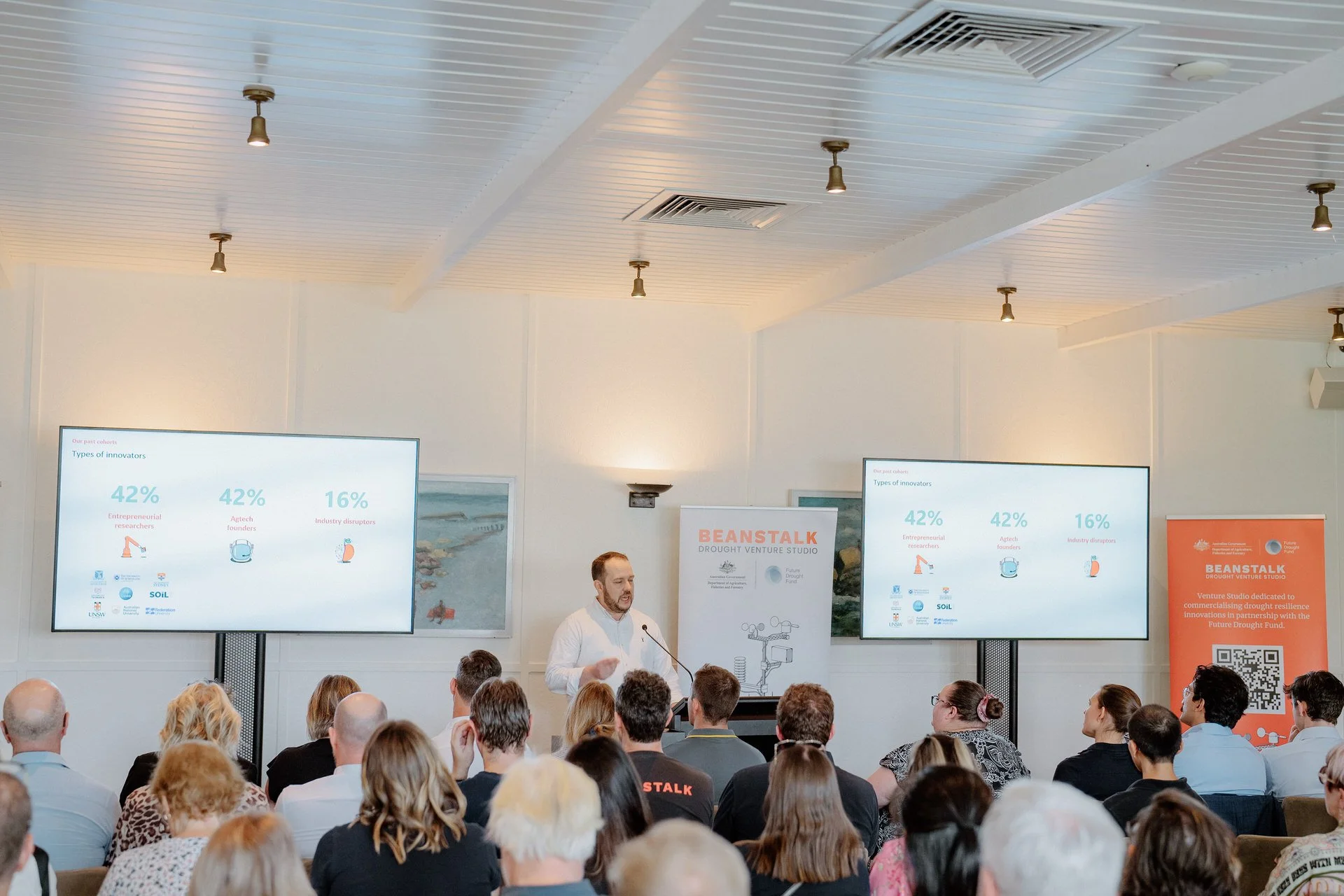
Entrepreneurial researchers with technologies ready to graduate from the lab to real-world ag applications.

AgTech founders with early-stage prototypes ready to validate and bring to market.

Industry disruptors with game-changing solutions ready to transform agriculture from the inside out.
What is the Beanstalk Venture Studio Model?
Tailored 1:1 Coaching
Dedicated weekly sessions to help identify and prioritise key risks, refine business model, validate assumptions, troubleshoot challenges, and set clear milestones throughout the program.
Expert Masterclasses
Targeted workshops on commercial viability, IP strategies, market analysis, and other critical early-stage topics.
Weekly Cohort Meetups
Collaborative sessions to share progress, exchange insights, and build a strong peer network.
Dedicated Pitch Practice
Structured coaching and rehearsals with real-time feedback to help innovators sharpen narrative and delivery for a commercial audience.
Specialist Support
Access to financial modelling, competitor research, visual design, and other specialist services.
Curated Connections
Curated opportunities to connect with industry experts, investors, and potential partners, with guidance on how to engage them at the right stage.
What did the innovators gain?

Entrepreneurial Capabilities
Skills, knowledge, and confidence in early-stage venture building, enabling innovators to tackle growth challenges and effectively lead their venture.
Venture Playbook
A pitch deck and commercialisation plan for communicating the opportunity for impact and the pathways for the next stages of growth.
Expanded Network
A strengthened network of peers, potential team members, advisors and investors for supporting the growth and success of the venture.
Industry Exposure
Creating visibility among a curated audience of investors, agribusiness leaders, and industry experts.
Showcase Highlights: Leading Ventures Across Four Cohorts
Cohort 1 Innovator Showcase, Sydney
Cohort 2 Innovator Showcase, Brisbane
Supported by our team of Venture Builders

Senior Venture Builder

Head of Venture Studio

Lead Venture Architect
Operations Lead

Venture Builder

Venture Builder

Venture Builder

Venture Builder

Venture Builder

Strategic Communications and Engagement Lead

Venture Builder
Frequently Asked Questions
Program details and benefits
-
Participation is free and non-dilutive, ensuring you can focus on building your venture without giving up equity or paying any fees.
-
None. For the next two years, the Drought Venture Studio is funded by the Australian Government’s Future Drought Fund. Due to the nature of this partnership, the Drought Venture Studio is not currently taking equity in new ventures. The investments made into new ventures are all non-dilutive.
-
During the program existing IP ownership will not be affected. For example, the IP associated with your innovation may be owned by a university or other research institute. Throughout the 12 weeks, if applicable, we will support you and the IP owner to understand the extent to which a new venture can access any required IP, such as through a licensing agreement.
Program Eligibility
-
Yes. A team can participate in the program, however, we do require that a single person be nominated as the primary innovator. This person will be expected to attend all of the sessions and is typically the project lead or startup CEO. The primary innovator should be the program applicant, and the application should list all core team members.
-
We have a very broad interpretation of what constitutes “drought resilience”. We have divided this challenge into 10 areas and examples of technologies that could fit within the broad definition we apply.
Water: This includes water management and storage; Irrigation and water use, water sources.
Financial Resilience: This includes alternate revenue streams, insurance and access to capital, new markets, employment, and risk.
Crops, Horticulture and Planting: This covers crop practices, crop choices, crop information availability, ground cover, animal feed crops and more.
Livestock: Including animal production, animal health and welfare, animal reproduction, grazing, carrying and stocking rates, and livestock biosecurity.
Soil: This includes land management, soil health and quality, soil moisture and more.
Pests and Weeds: This covers anything to do with pest management, weed prevention, and fertilisers.
Environment: Including environmental ecosystems, environmental sustainability, natural resource management, bushfires and back burning, forecasting and more.
Community Resilience and Wellbeing: This includes personal and familial wellbeing and mental health, cost of living, community resilience, and social connection.
Information and Knowledge Sharing: This covers things like drought-specific information, knowledge sharing, decision-making, planning tools and software.
Supply Chain Management: Including crop yield and quality, cost and price volatility, supply chain and logistic disruptions, market access, waste management, and more.
These areas cover a very wide spectrum of potential innovations across technologies as diverse as biology, hardware, biotech, data and algorithms, IoT and sensors, software applications, and much much more. We encourage you to apply even if you’re not 100% sure your innovation qualifies, and we can respond to you with any more information you might need to include.
-
We have a broad view of what constitutes innovation in drought resilience. We consider a range of technologies (such as software, hardware, and biologicals) with a focus on things that are novel and defensible. So it is not essential that you have taken formal steps around protecting your intellectual property - and it is not essential that you have (or will one day need) a patent. It might be just as likely that your innovation revolves around trade secrets (which can be the foundation of a venture’s intellectual property). The bottom line is that if you have an emerging technology that is novel and defensible (and originates in Australia), it will certainly qualify as the type of innovation we can support you with.
-
You must be an Australian citizen, permanent resident, or have your IP (technology/innovation) housed in an incorporated company entity to be eligible to apply. Please note that this requires at least an ACN (not just an ABN). You will need to do your own research to clarify the difference.
There is a narrow exemption to these eligibility in some cases where the main criteria are not satisfied and there is an international innovator or innovation with novel IP and evidence of intent to bring the innovation to Australian farmers. Please contact us if you think this exemption might apply to you.
-
No, innovators that have participated in other accelerator programs can still be considered for the Drought Resilience Lab.
-
The short answer is yes. We are proud to be part of a growing ecosystem of organisations that helps advance agtech ventures in Australia. We will judge applicants purely on our selection criteria. If your innovation also qualifies for other programs’ selection criteria, terrific!
-
We welcome entrepreneurial researchers, early-stage founders, and industry disruptors who want to transform validated prototypes into impactful ventures that contribute to drought-resilience.